
MATERIALS ANALYSIS SERVICE SUPPORTING INDUSTURY AND RESEARCH
Secondary Ion Mass Spectrometry (DSIMS)
SIMS is an extremely sensitive sputter depth profiling technique used to measure the concentration of dopants and impurities in solids as a function of depth. A variation is to use ultra-low energy primary beams (ULE SIMS) which significantly reduces the near surface 'pre-equilibrium' region; essential for accurate near surface & low energy implant analyses. This also markedly reduces the 'ion beam mixing effects' thereby providing a depth resolution of 1-2 nm under non-roughening conditions.
If sputter induced roughening is unavoidable (as in metals or polycrystalline materials) sample rotation is the best route for achieving good depth resolution.
Applications
-
Dopant Diffusion Profiling: e.g. B, P, As in Si; N and Al in SiC and Zn, Si, Be etc in compound semiconductors
-
Dose Measurements: Implant dose and energy, including low energy implants.
-
Impurity Measurements: Trace elements (e.g. O, C, N, H) introduced during synthesis, deposition, or growth.
-
Matrix Composition: Quantitative measurement of matrix composition of heterostructures in compound semiconductors.
-
Reverse Engineering: Doping concentrations, diffusion profiles and layer thicknes
Also see SRP Analysis and TOF SIMS
Materials
-
Silicon Technology
SiC , SIGe, Barrier Oxides, PSG, BPSG -
III-V Compound Semiconductors
GaAs, AlGaAs, InP, AlInP -
Nitrides (Wide-Bandgap Materials)
GaN, InGaN, AlGaN, CdTe
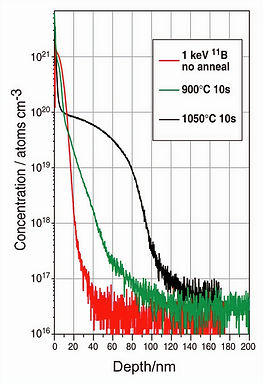
SIMS of 1 keV B implant in Silicon